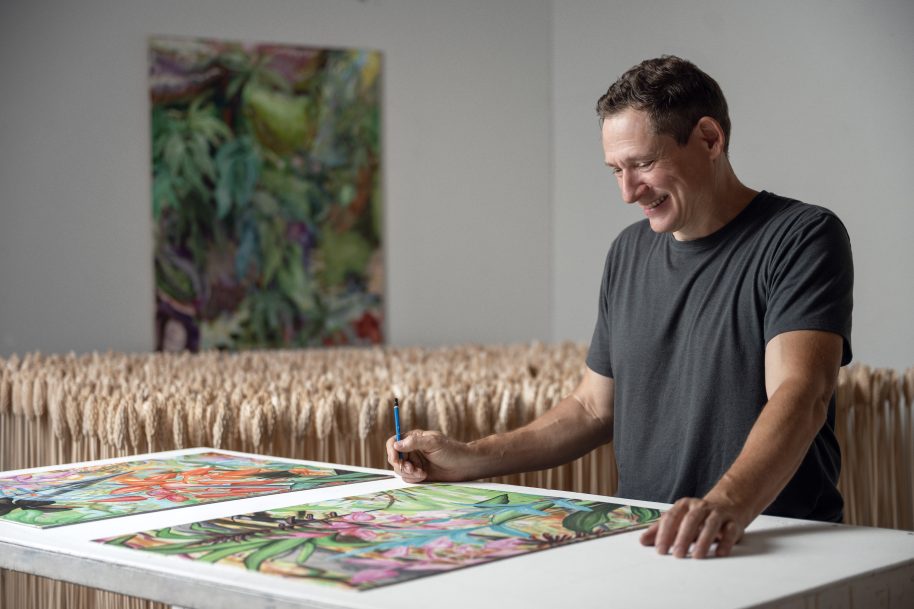
Kurt Lightner has spent more than two decades mining his familial landscape — the farms, forests and laboring lives of rural Ohio that shaped him and continue to define his practice. Born and raised in Troy, Ohio, Lightner works from memory, old family photographs and firsthand knowledge of every place he depicts, capturing not photographic detail but the emotional essence of recollection. We spoke with Kurt about the Spark series, the Emerald Ash Borer beetle and what it means to find hope in devastation. His two new Haystack editions from the Spark series are available now.
 Kurt Lightner in his studio.
The Spark series is rooted in the woods you grew up in near Troy, Ohio — what made you want to return to that specific landscape now, for this body of work?
My work for the last 20 or 30 years has referenced my familial landscape. Whether it be family or the natural world, I mine these aspects and their impact on me. Spark comes from visits back to what was, until recently, my parents’ home and where I grew up in Troy, Ohio. Whenever I would go home to visit my family, my trip wasn’t complete without a walk back into the woods. Behind the house stood a five-acre wood — a place that has stood there as long as there have been trees. It is a slice of the original hardwood forest that blanketed most of the northeast before the arrival of Europeans to this land. My grandparents’ farm kept this island of native trees — a source of refuge for animals and insects, but even more so my own refuge in the natural world. Over the years I had begun to witness the devastation the Emerald Ash Borer beetle brought to the woods. This impacted me deeply, and I wanted to address it in my work.
Can you tell us more about the Emerald Ash Borer’s impact on the forest, and what it was like watching that destruction open up new light and growth?
The Emerald Ash Borer beetle found its home in the forests of the northeastern United States. I began to see the devastation around 2006. Large chunks of bark started to separate from massive trunks, giving way to the tell-tale squiggly lines left by larvae tunneling through the cambium layer — cutting off the nutrient and water supplies that even the healthiest trees would eventually succumb to. The skeleton structures were left bare, the heartwood standing naked and exposed. Even after their death, they stood for many years.
On a trip home over the holidays in 2022, I ventured back into the woods one cold morning and found it almost empty. Before entering, the view from the outside seemed normal — lush even in winter, with many trees blocking the view inside. But once you stepped through, it was a very different story. I was used to the winter light having more strength, allowed in by the absence of the summer canopy, but this was different. It wasn’t just the leaves that had fallen away — it was the trees themselves. Massive openings to the sky, the ground littered with giant trunks and limbs. Trees caught in other trees on their way down, hovering in an in-between space with a palpable gravity overhead. I wandered through the gauntlet of logs and limbs toward the center of the woods. It opened all the way to the sky, blocked only at times by the diagonal line of a tree not yet fully fallen. Massive loss.
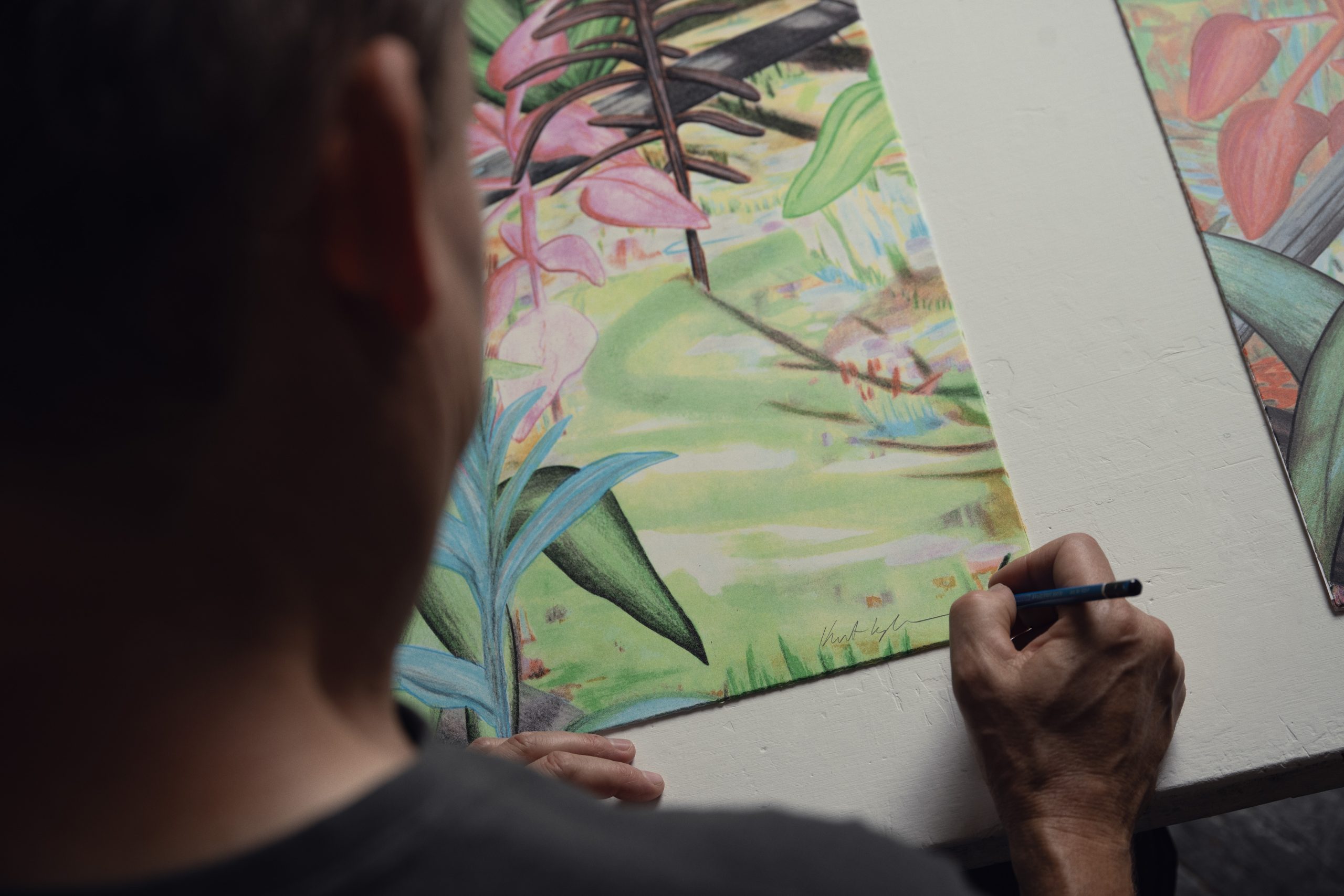
 Kurt Lightner signing Spark I
The Spark series is rooted in the woods you grew up in near Troy, Ohio — what made you want to return to that specific landscape now, for this body of work?
While contemplating that loss, I noticed the light. A light of great quantity, rushing and bathing the ground in ways it hadn’t in decades — or perhaps centuries. Waking up voids and fissures in the ground as if the morning had finally arrived. With light comes life. This space only exists because of its power to regenerate. Even in the small span of time I had engaged with that place on earth, I had seen the results of this regeneration — watching trees reemerge from the harvesting of timber for my grandparents’ barn, growing into massive trees filling in the void. I stood there realizing I was witnessing the next iteration. The beginning of what it will become. The hope of a future stronger and more resilient. These trees will bring new life as they lay and rot on the ground — homes for thousands of insects and organisms ready to flourish. The soil will be enriched, causing a flush of new growth and flora in ways it hasn’t seen in years. Saplings will stake their claim, and the rush is on to see which will be the mightiest. I navigated myself back through the woods to its borders, feeling hopeful for its future.
You use stencils and a collage-based process to build these compositions — how did that technique evolve, and what does it let you do that painting directly couldn’t?
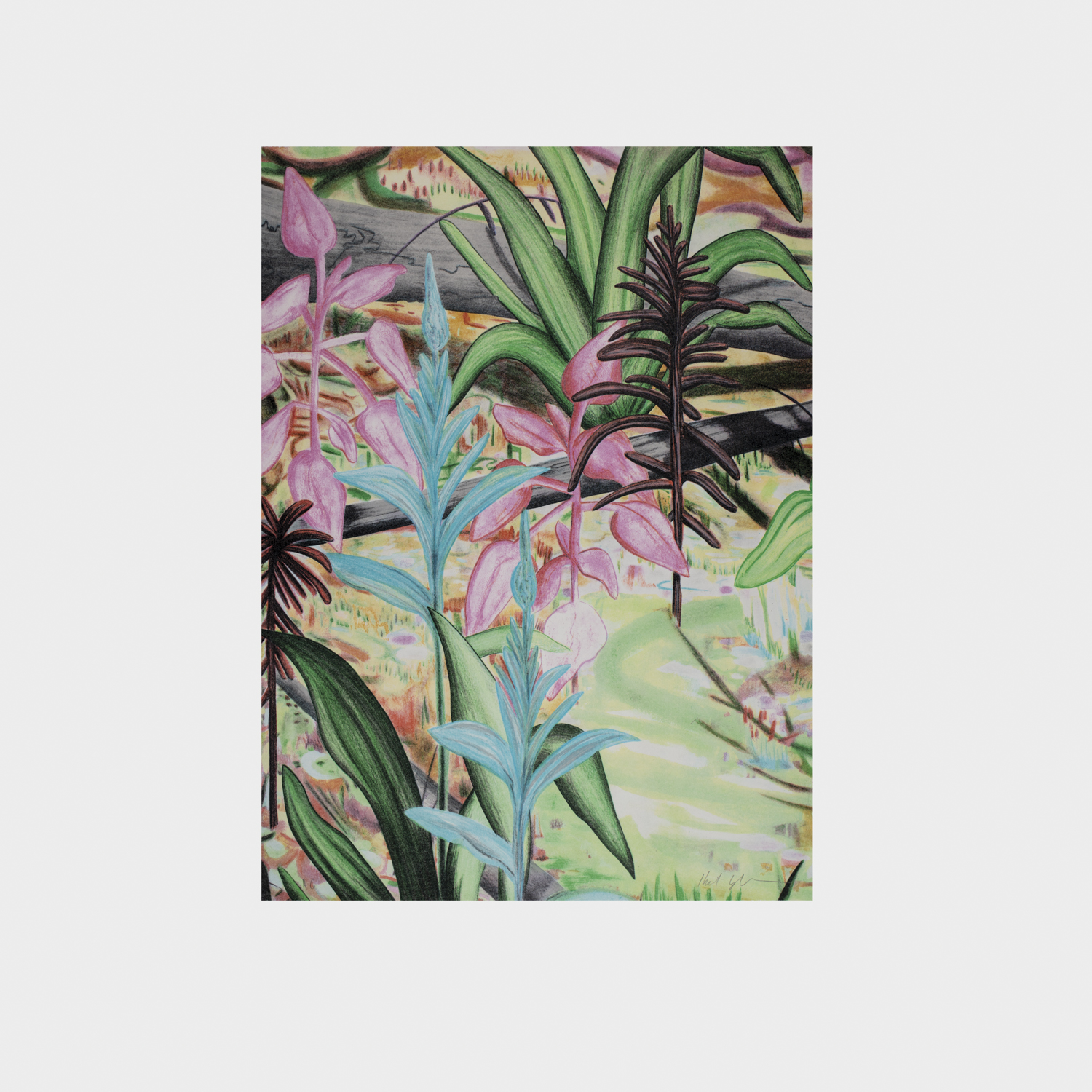
Collage has been part of my practice from the earliest days of my art making. It has flowed in and out of my studio work in differing ways over the years. With the Spark series, I began making stencils of plants. These stencils were used to help with the overall layout — a kind of hands-on Photoshop — allowing me to move elements around the composition and make decisions without painting and repainting. They were also used to lay over existing painted areas, which I would then trace around and gesso, creating the ability to paint over areas while keeping things light and allowing for more flexibility in compositional decision-making. The cutouts did not physically remain in the painting — they were used purely as a tool in making it.
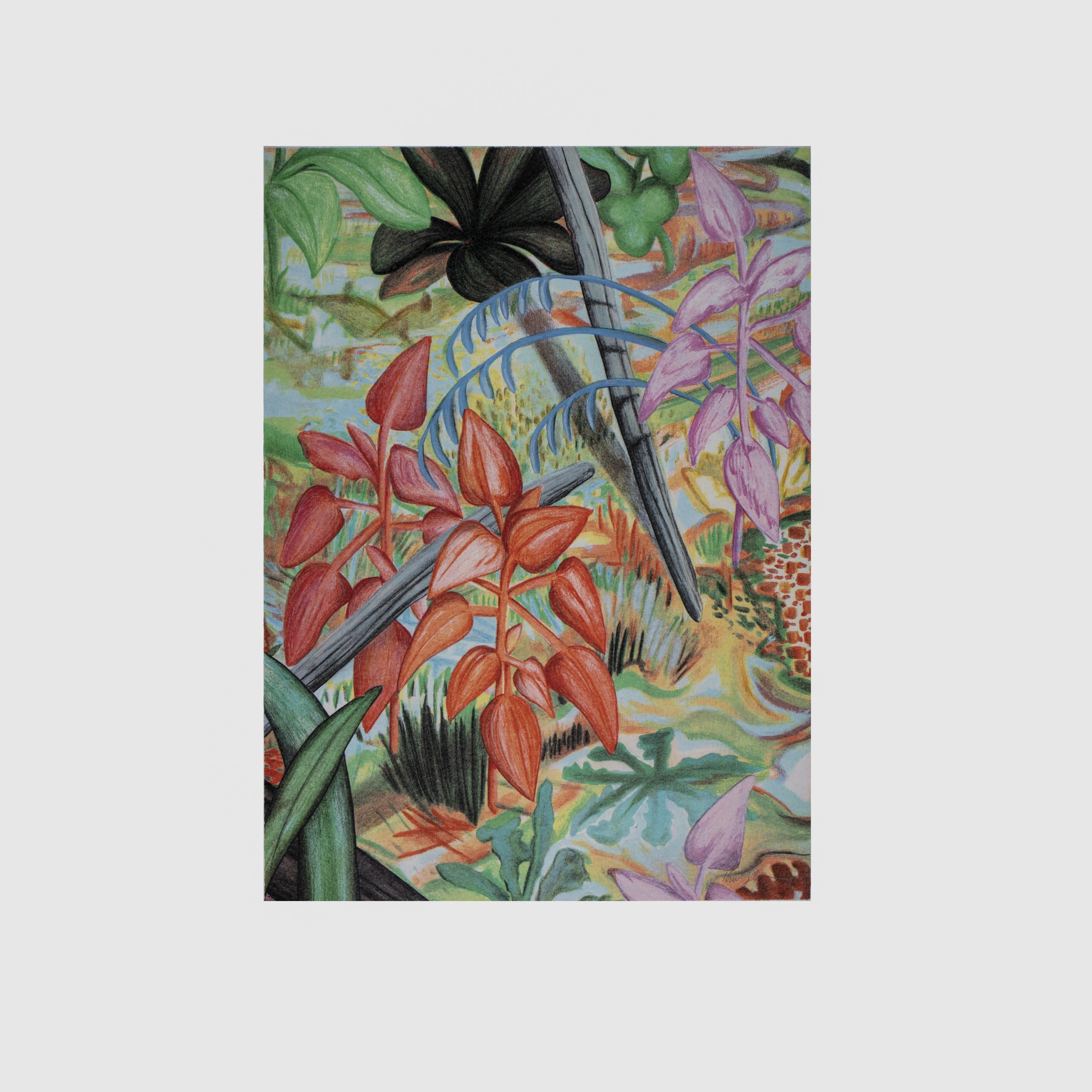
Your earlier editions with us — the Cathedral Series — also drew on landscape and memory tied to your Ohio roots. How does this new edition from Spark feel like a continuation of that exploration, or a departure from it?
My hope as an artist is that there is a through line in my work. For me, it’s my familial landscape. Whether the work addresses places of labor — like the Cathedrals of Work series — or, as in Spark, views the natural world as a lesson in change, resilience and hope, I think they both continue the same exploration.
Interested in adding a Kurt Lightner edition to your collection? His new Spark series editions are available now, exclusively on Haystack. Click here to learn more about Kurt Lightner.